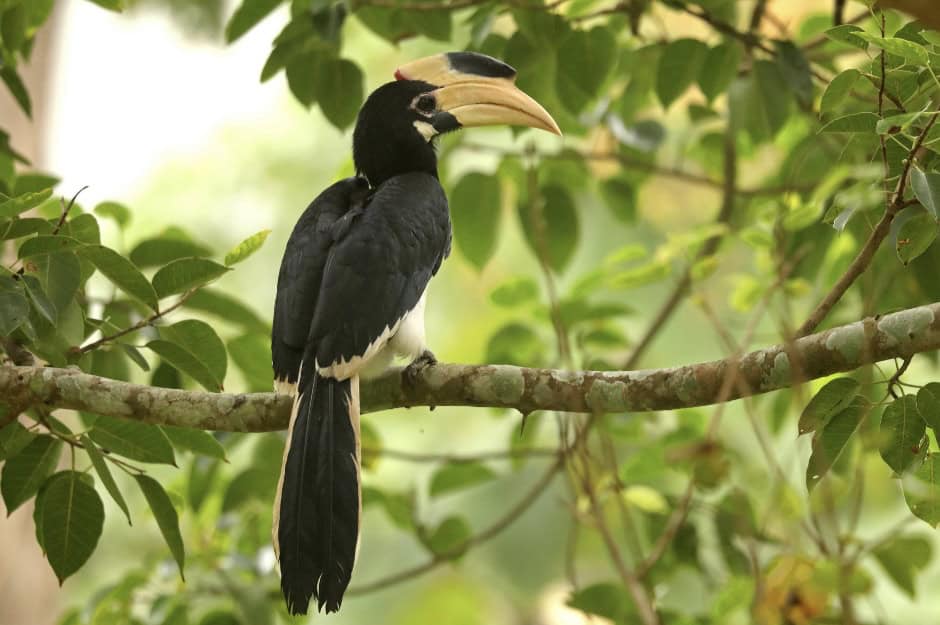
There are moments in nature that remind us just how special and fragile our island ecosystems truly are. Recently on Koh Jum, local wildlife watchers were rewarded with something extraordinary, the sighting of what appears to be two hornbills, marking the first confirmed observation on the island in more than a decade.
Hornbills are among Southeast Asia’s most iconic birds. Belonging to the family Bucerotidae, these large, striking birds are characterized by their long, curved bills and prominent casque on the upper mandible, features that make them unmistakable in flight or perched in the treetops.
While Thailand is home to at least 13 species of hornbill, many of them are rare, threatened, or declining due to habitat loss, fragmentation, and hunting pressure. Some species, such as the critically endangered Helmeted Hornbill, face extremely low population numbers and are afforded the highest levels of legal protection.
The recent sighting on Koh Jum, likely of an Oriental Pied Hornbill (Anthracoceros albirostris), a species that occurs across parts of Southeast Asia, is notable not only for its rarity here but also for what it may signal about the health of our island’s forests and fruiting trees. Hornbills are principally frugivores, feeding on a wide variety of forest fruits and playing a crucial role as seed dispersers in tropical ecosystems.
For residents and visitors alike, spotting a hornbill can be a moment of wonder, a reminder that even in places where wildlife sightings have become uncommon, nature can still surprise us. Their presence here invites curiosity, respect, and a renewed sense of stewardship for the landscapes we share.
As the sun sets over Koh Jum’s forests and shorelines, the memory of these remarkable birds stands as an invitation: to look up, to listen, and to remember that the wildness we cherish is still very much alive.
Head to our YouTube channel here to see our video sighting