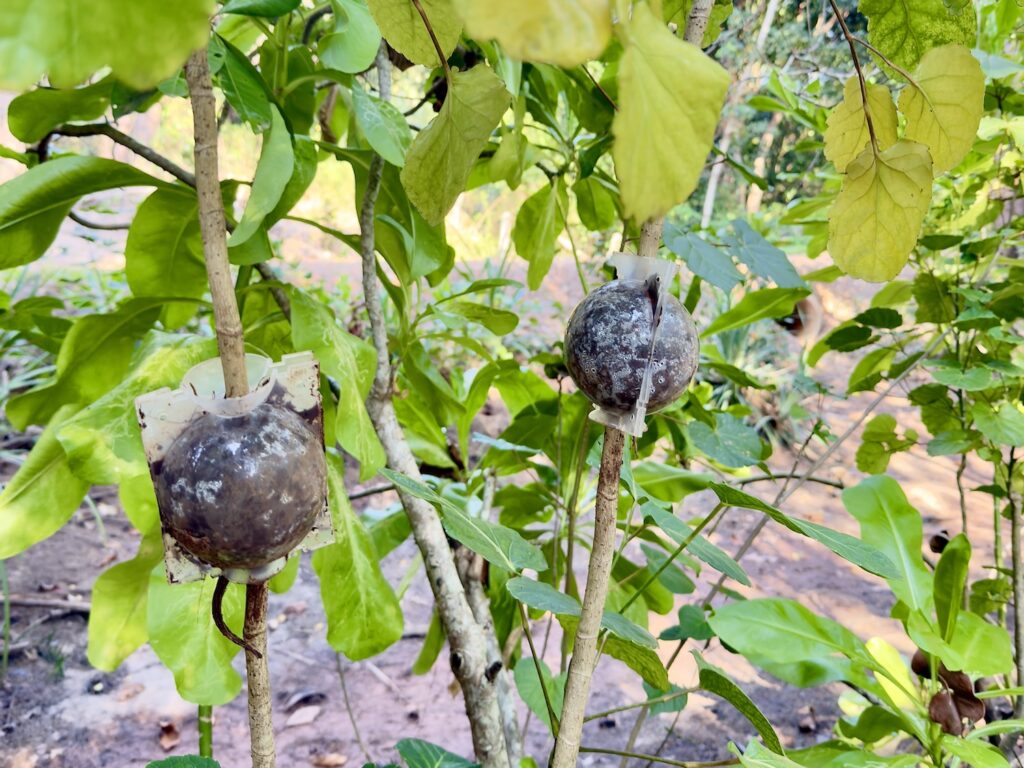
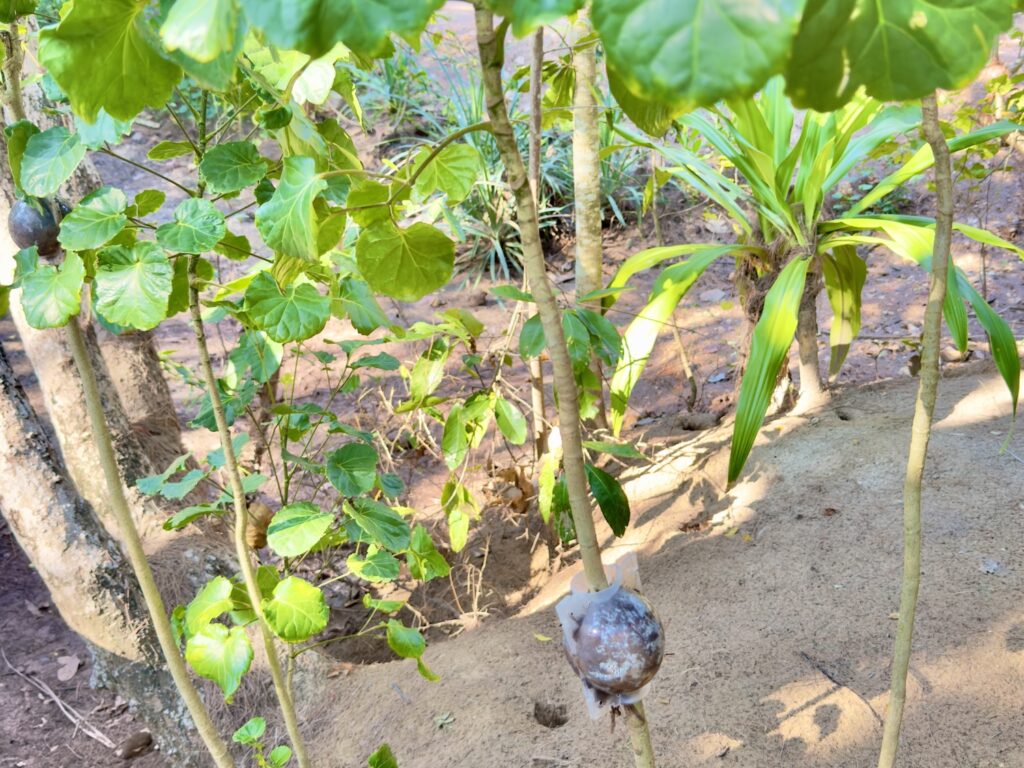
Look closely at the trees around the property and you will find small parcels of dark earth bound to the branches and sealed in clear ball. They appear all around our property and there are usually a few in progress at any time.
They are not decorative. Each one is a new plant forming.
What is happening inside the ball
This propagation technique is called air layering. It is used widely across Southeast Asia and it is done here by hand, with nothing that has to be brought in.
A narrow ring of bark is lifted from a branch. The wound is packed with damp growing medium, then wrapped and sealed so that moisture stays in. The tree cannot move its sugars down past the cut, so it puts out roots at the wound instead.
After a few weeks, roots become visible through the ball. The branch is then cut below the new root ball and planted into the ground, where it continues as an independent plant.
The parent tree closes over the small scar and carries on growing.
Why we do it this way
Two practical reasons:
The first is that we are not shipping plants in. Everything that arrives on Koh Jum arrives by boat, and nursery stock arrives in plastic pots or wrap, raised in soil that is not ours and on a feeding routine it then has to adjust away from. Propagating on site removes the freight, the packaging and the adjustment.
The second is time. A seedling starts from nothing and takes years to reach any useful size. An air layered branch is already several seasons old when it goes into the ground. It skips the slowest stage entirely, and because it is genetically identical to the plant it came from, we know exactly what we are planting and how it behaves in this soil, this salt and this rainfall.
What it does for the garden
The point of all this is density. A garden that can multiply itself keeps filling in rather than thinning out.
More canopy means more shade and cooler ground beneath it. More layers of planting means more habitat for birds, insects and pollinators. More root structure means soil that stays where it is through the rainy season. Fruiting and flowering plants extend what is available to wildlife across more of the year, and some of it reaches our kitchens.
None of this is dramatic. It is ordinary garden work, repeated, that keeps the place healthy and biodiverse without importing anything to do it.
It sits alongside the rest of how the property is run: organic gardens supplying the kitchens, our long standing relationship with the Chao Ley and Muslim communities here on Koh Jum, and Travelife Gold certification, which requires us to evidence these practices rather than simply describe them.
See it for yourself
You find the layering balls, around the resort gardens and guests are welcome in our organic garden at any time.
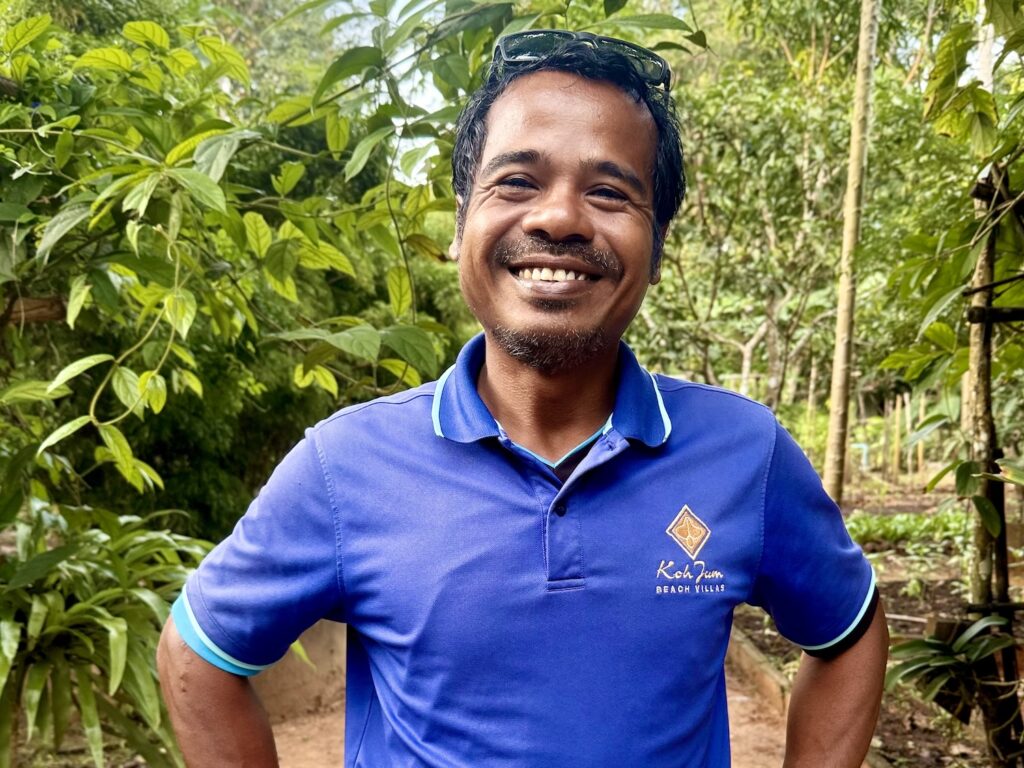
You will usually find Khun Aod there. He is a local Chao Ley, he manages our gardens, and he is happy to talk through what is currently rooting, what is going into the ground next and how any of it works.
It is worth the walk.